
The framework, applied to itself.
How the RTC Method decided the order you'd meet it in.
Every methodology runs into the same problem.
To value the thinking, you need to see what it can do. To see what it can do, you're usually asked to learn the thinking first.
Read the book. Take the course. Attend the workshop. Trust that the payoff arrives somewhere around chapter nine. You pay first, and find out later whether it was worth it.
That's the order most frameworks follow, and it asks a lot of people before it gives them anything. Explanation first. Demonstration later, if they're still around.
We started with the assumption nobody had questioned.
The assumption was that understanding has to come before experience. People need the theory before they'll value the result.
But that isn't how people come to believe in most things. Nobody studied how search engines index the web before deciding Google was useful. They typed a question and got an answer. The understanding, if it came at all, came later.
So the question changed. It stopped being "how do we explain the RTC Method better?" and became "what if people met the result first?"
Borrowing a principle that already works somewhere else.
This one came from the companies that rewrite categories. Disruptors rarely win by explaining. They win by letting people experience the thing, then letting curiosity do the rest. The product is the argument. The explanation is there for anyone who wants it.
Applied to a way of thinking, the principle looks awkward at first. A methodology isn't a product. You can't hand someone a framework and let them take it for a spin.
Unless you build something that runs on it.
So we did. ARGUS and PROTEUS are the RTC Method in working form.
ARGUS is vision. It examines a document, a strategy or a decision, and shows what's strong, what's missing and what deserves a harder look. PROTEUS is discovery. It goes looking for the angles nobody had thought to consider.
Neither asks you to learn the method first. You bring the problem, and the thinking shows up in the result.
If the result makes you wonder how it got there, that's where the framework comes in.
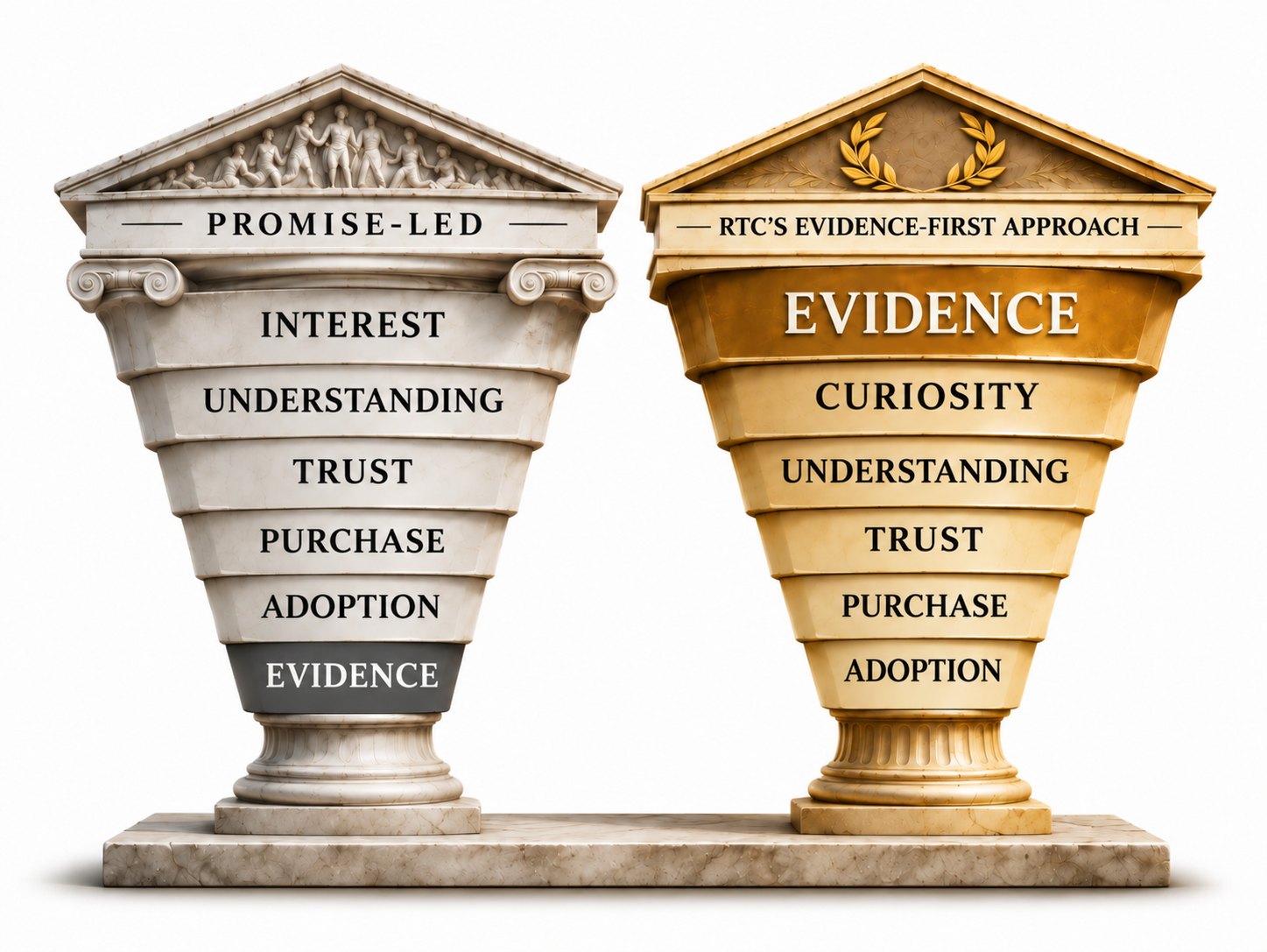
An example of the thinking applied to itself: the application creates interest in the methodology.
A decision, not a proven law.
We're not claiming to have rewritten how people learn. We made a choice about sequence, using the same method we'd ask anyone else to use, and we're testing it in the open.
A demonstration shows what the thinking can find. Whether acting on it pays off is still yours to prove.
If it works, the tools will make the case better than any explanation could. If it doesn't, the method will tell us what to reframe next.
Either way, it seemed only fair to apply the thinking to ourselves before asking anyone else to.
See what the thinking can do. Then discover what makes it possible.